

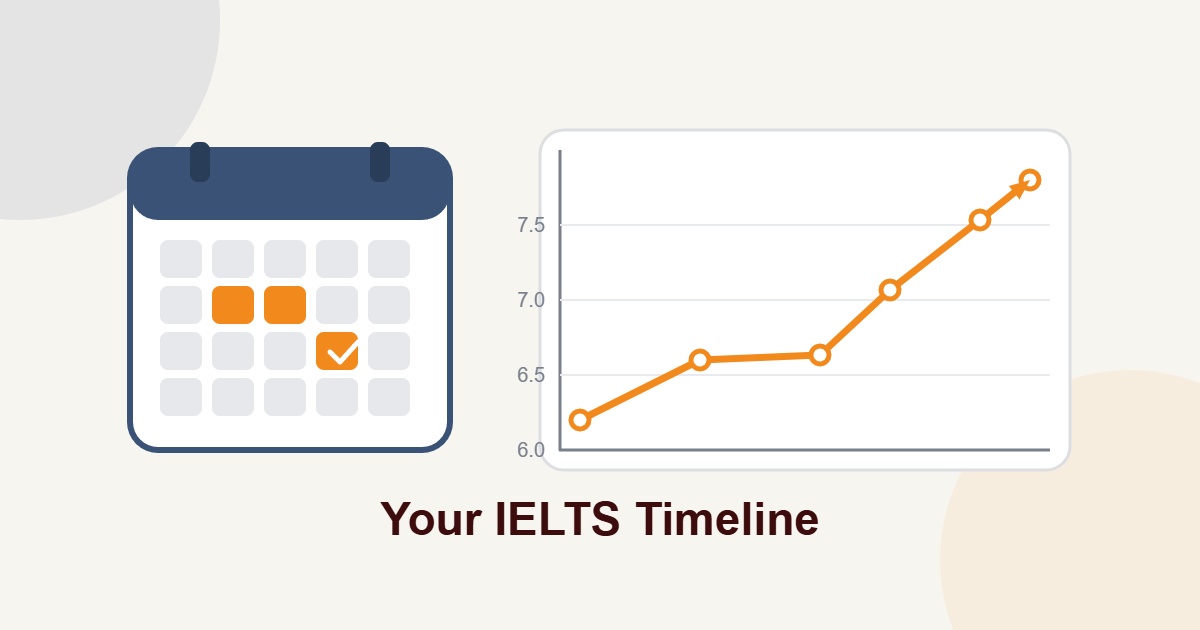
How Long Will It Actually Take You to Reach Your Target IELTS Score?
It’s one of the first questions almost every new student asks me: “Tom, how long will this take?” I hear some version of it several times a week, and I understand why. You’ve got a deadline — a university offer, a visa application, a job — and you need a number you can plan around.
The standard answer you’ll get from most IELTS teachers is that each band score increase requires roughly 100 hours of study. It’s a tidy number. It fits neatly into a study plan, it sounds authoritative, and it gives students something concrete to hold onto.
I’ve never liked it.
Why the 100-hour rule doesn’t tell you what you need to know
The 100-hours-per-band figure isn’t made up — it comes from research into how long it typically takes to move between proficiency levels in English generally. But “typically” is doing a lot of work in that sentence, and it flattens something I see in my classroom every single week: two students can start at exactly the same level, put in the same number of hours, and end up in completely different places.
Some students improve remarkably quickly. A few weeks of focused work and their score jumps a full band. Others put in the hours — real, honest, effortful hours — and barely move at all. If the number were reliable, that gap shouldn’t exist. It exists because “how long will it take” isn’t really a question about hours. It’s a question about what’s actually holding your score down, and that’s different for every student.
The two kinds of problem — and why they matter
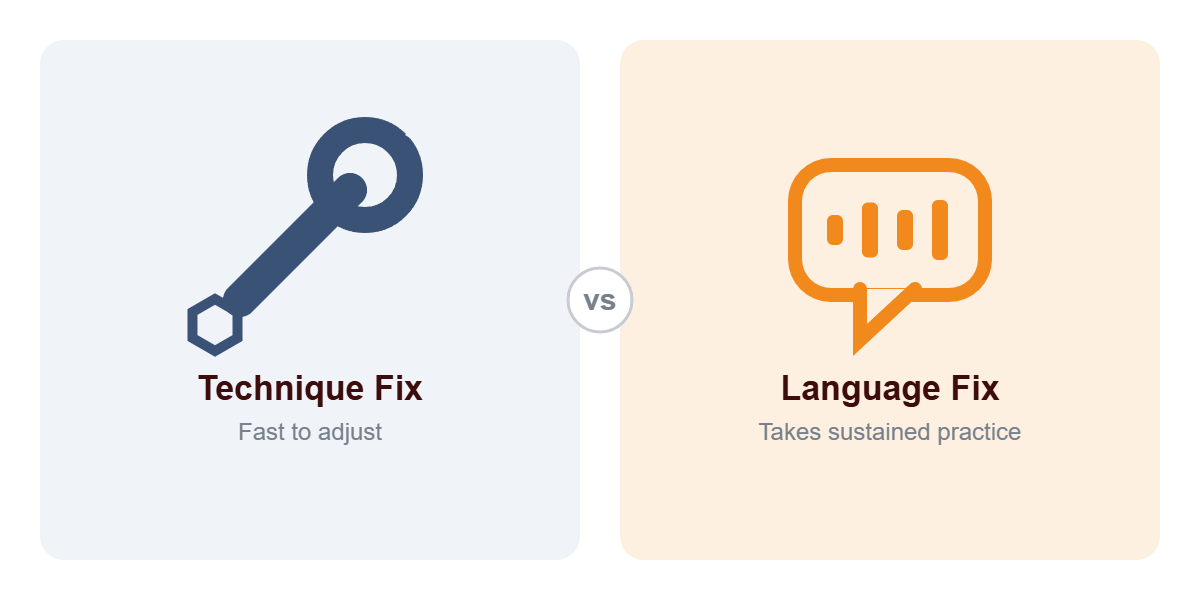
After twenty years of doing this, I’ve come to think there are really two categories of problem, and knowing which one you have matters more than any hours-based formula.
The first kind is easily fixed. This is technique — how you approach the questions, how you structure your response, what you do (or don’t do) in the first thirty seconds of an answer. I see students held back a full band, sometimes more, purely because nobody ever showed them how a good Part 2 answer is built, or how to structure a Task 2 essay so the examiner can follow your argument without effort. Fix the structure and the score moves fast, often faster than any 100-hour rule would predict, because the English was already there — it just wasn’t being presented in a way the exam rewards.
The second kind is harder to solve. This is fluency and grammar — the actual mechanics of the language. If you’re pausing to search for words mid-sentence, or your grammar is inconsistent under pressure, that’s not a structural fix. That’s a language-level issue, and language takes longer to change than habits do. It responds to sustained practice, not a few clever tricks, and anyone who tells you otherwise is selling you something.
Most students are a mixture of both, which is exactly why a single number can’t capture their timeline. A student who’s 80% structure and 20% fluency will move fast. A student who’s the reverse will need patience — and a study plan built around real language development, not shortcuts.
So how long will it take you?
Honestly, I can’t tell you that until I’ve heard you speak or read your writing. What I can tell you is that the question is worth asking properly, because the answer changes everything about how you should be spending your study time. If your problem is structural, hammering out practice essay after practice essay without ever addressing how they’re built is just repeating the same mistake for 100 hours instead of fixing it in ten. If your problem is fluency or grammar, no amount of clever exam technique will paper over language that isn’t there yet — that needs real, sustained work.
This is exactly why I offer a free Band Score Assessment — not to give you a number, but to work out which category you actually fall into, so your study time goes where it will actually move the needle.
The good news, if your test is in October
If your exam is in October, you have more time than you probably think. That’s genuinely enough time to make real progress on either kind of problem — plenty of time to fix a structural issue almost entirely, and enough time to make meaningful headway on fluency and grammar if you start now and stay consistent. The students who struggle aren’t usually the ones who started “too late” by some fixed hours-based deadline. They’re the ones who spent their available weeks working on the wrong thing.
Figure out which kind of problem you actually have. Then use the time you’ve got to fix that one.
Interesting Phrases and Vocabulary
- Plateau: A period where progress stops and your level stays the same, even though you keep practising.
- To move the needle: To make a noticeable, meaningful difference to a result.
- Tidy number: A figure that sounds neat and convincing but may be an oversimplification of something more complicated.
- To hold someone back: To prevent someone from progressing or achieving their potential.
- Under pressure: In a stressful or high-stakes situation, such as during an exam.
- To paper over (something): To hide a problem temporarily instead of properly fixing it.
- Shortcut: A quicker way of doing something that skips some of the necessary steps or effort.
- To flatten (an idea): To oversimplify something complex so that important differences or details are lost.
- Headway: Progress, especially progress that has been difficult to achieve.
- To hammer out (something): To produce something, often repetitively or with effort, such as practice essays.